

San Diego Supercomputer Center Celebrates the 55th Anniversary of the Protein Data Bank
Published October 26, 2026
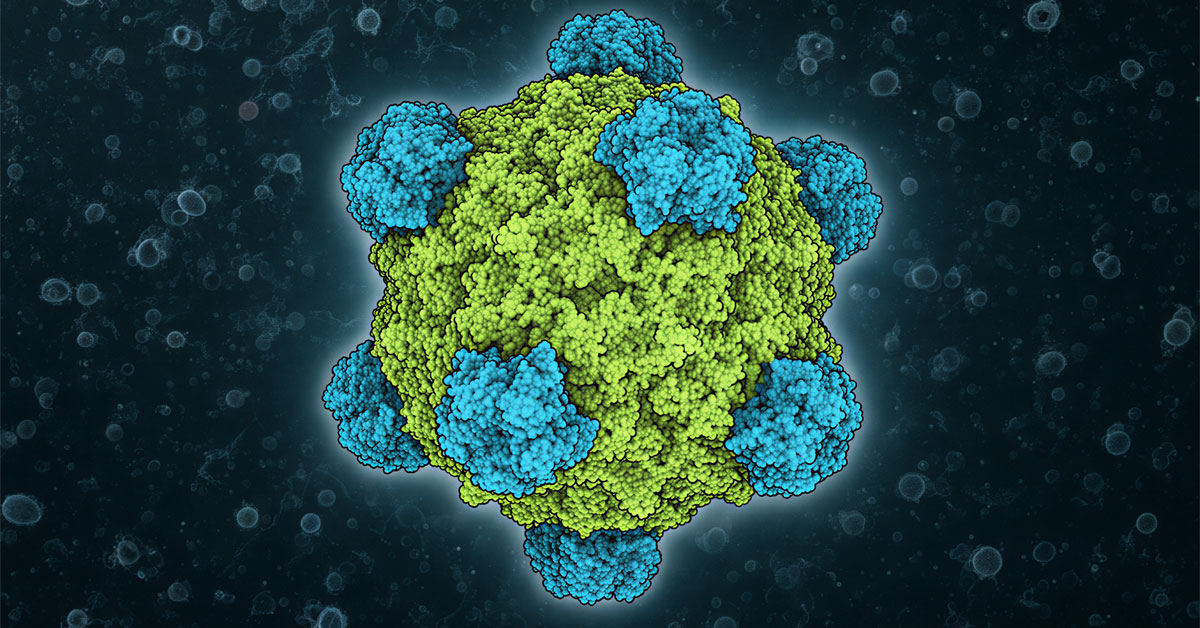
RCSB PDB’s Molecule of the Month series highlights important structural stories. The October column, Celebrating 55 Years of the PDB, describes how PDB data are enabling the rapid evolution of protein structure prediction and design. Shown is the synthetic bacteriophage Evo-Φ36 (pdb_000036cr). Credit: Janet Iwasa and RCSB PDB
The Protein Data Bank (PDB) was established by the scientific community in 1971 as the first open-access digital data resource in biology, with just seven X-ray crystal structures of proteins at its start.
This month — its 55th anniversary — the PDB has accumulated more than 260,000 atomic-level, three-dimensional digital models of the building blocks of life.
The PDB is hosted within the Halıcıoğlu School of Data Science and Computing San Diego Supercomputer Center (SDSC) at the University of California San Diego. Its vast collection of proteins, viruses and macromolecular machines — protein or nucleic acid complexes that act as tiny engines inside cells — are fundamental for education and scientific research in biology, energy sciences, medicine and biotechnology.
“The information archived in the PDB is distributed around the world at no cost to the user and with no limitations on data usage,” said Research Collaboratory for Structural Bioinformatics PDB Director Stephen K. Burley. “This wouldn’t be possible without our partnership with SDSC and our Worldwide PDB Partners. We see downloads of structures happening at a scale of around 10 million data files each day, with more than a terabyte of biological information for users to search through.”
Initially, the archive was hosted at Brookhaven National Laboratory, where structure information was collected and distributed by physical mail, through either punched cards or magnetic tape.
Today, PDB data are contributed online by research labs located on every inhabited continent, and carefully curated and distributed by a global partnership called the Worldwide Protein Data Bank (wwPDB). The wwPDB consists of data centers in the US, Europe and Asia. RCSB PDB, the wwPDB U.S. data center, is a collaboration between SDSC/UC San Diego, Rutgers, The State University of New Jersey and the University of California San Francisco.
The PDB archive is growing in size by about 10 percent each year. Every one of these data submissions is rigorously validated and expertly curated by the wwPDB before release. Once publicly available, PDB data can be accessed, visualized and analyzed using specialized RCSB PDB tools and resources. RCSB.org helps users understand how the structure of a biological macromolecule is essential for understanding its role in human and animal health and disease, its function in plants and food and energy production as well as its importance to other topics related to global prosperity and sustainability.
The structures contained in the archive have been cited in more than a million published research papers, and the cost to replicate the entire corpus of data has been estimated to be at least $27 billion. Open access to PDB structure information facilitates discovery and development of life-changing drugs. The impact ranges from understanding target biology by identifying a given target as likely druggable to structure-guided optimizing of drug potency and selectivity.
Between 2010 and 2023, the U.S. FDA approved 88 new small-molecule anti-cancer drugs. PDB data informed the sponsor company’s understanding of target biology and target druggability for every single one of these drugs, and in many cases provided no-cost starting points for structure-guided drug discovery.
The enormous wealth of 3D structure data stored in the PDB has underpinned significant advances in our understanding of protein architecture, culminating in recent breakthroughs in computational protein structure prediction – accelerated by artificial intelligence approaches and deep or machine learning methods. Nobel Prize-recognized applications of PDB such as AlphaFold and RoseTTAfold, which predict protein structures based on amino acid sequences, are changing the ways researchers are studying structural biology and molecular machines. RCSB.org offers access to more than one million of these predicted computer structure models using the same tools available to explore the PDB archive.
RCSB PDB Core Operations are funded by the U.S. National Science Foundation (grant no. DBI-2321666), the U.S. Department of Energy (grant no. DE-SC0019749), the National Cancer Institute, National Institute of Allergy and Infectious Diseases and National Institute of General Medical Sciences of the National Institutes of Health (grant no. R01GM157729).