

New Tool Uses SDSC’s Expanse to Help Scientists Develop Longer-Lasting Vaccines
Published November 04, 2026

Porcine Parvovirus. Credit: iStock
Many vaccines, gene therapies and other virus-based medicines lose effectiveness when not stored and transported under carefully controlled conditions. To keep them stable, scientists add ingredients called excipients, which are substances that help protect viruses and extend their shelf life.
Finding the best combination of these protective ingredients, however, is a major challenge. Traditional computer simulations require scientists to model entire viruses, which can take months to years of supercomputing time and consume significant computing resources.
To address this problem, researchers at the University of Minnesota developed a new computational tool called CapSACIN (Capsid Surface Abstraction and Computationally-Induced Nanofragmentation). The research, published in the Journal of Chemical Theory and Computation, used U.S. National Science Foundation (NSF) ACCESS allocations on the Expanse system at the San Diego Supercomputer Center (SDSC), located at the University of California San Diego Halıcıoğlu School of Data Science and Computing.
Rather than simulating an entire virus, CapSACIN focuses on specific regions of a virus's outer shell, known as the capsid. By using simulations to study only the most important areas, researchers can quickly evaluate how different stabilizing ingredients interact with the virus while using far less computing power.
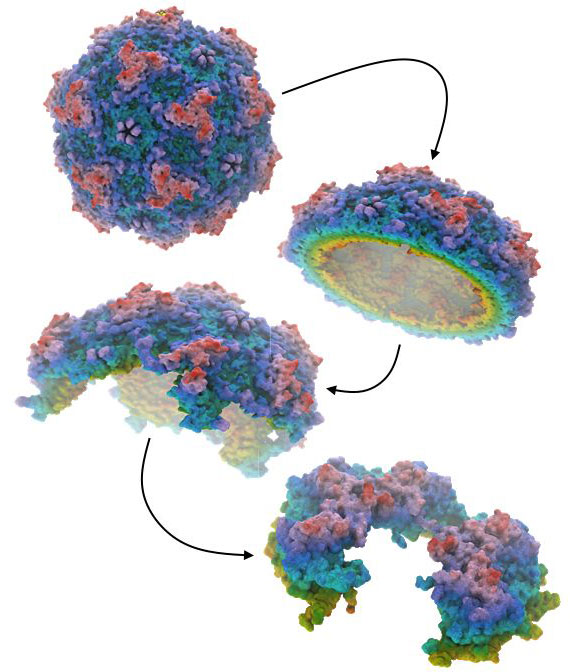
The team tested CapSACIN using Porcine Parvovirus, a virus commonly used in stability studies. They examined several regions of the virus's outer shell and measured how each responded to mechanical stress. The results revealed that some areas were naturally stronger than others, helping scientists better understand which parts of the virus are most vulnerable to damage.
CapSACIN also predicted that the excipients sorbitol and trehalose would provide the greatest stability for the virus, while glycine would be less effective. These predictions closely matched results from wet-lab studies, providing strong evidence that the new tool works as intended and can significantly reduce the time and expense required to develop new vaccines, gene therapies and other biologic medicines.
“Our study, which relied heavily on the NSF ACCESS allocations on SDSC’s Expanse, shows how advanced computing can complement traditional wet-lab experimental research,” said Sapna Sarupria, an associate professor of chemistry at the University of Minnesota.
“As vaccines and gene therapies become increasingly important, tools like CapSACIN could help researchers identify effective formulations more quickly and reduce the trial-and-error process that currently slows development,” she continued “This will have the potential impact of saving billions of dollars for the biologics industry.”
By combining molecular biology with high-performance computing, CapSACIN offers a faster and more sustainable way to develop stable virus-based medicines, helping researchers develop stable virus-based medicines more efficiently.
This work was supported by NSF DMREF (grant nos. 2118788, 2118693 and 2325392). The computational work on Expanse was supported by NSF ACCESS (allocation no. CHE240118).