
“hpcGPT” Project Wins Best Student Paper at PEARC 2026
Published October 06, 2026
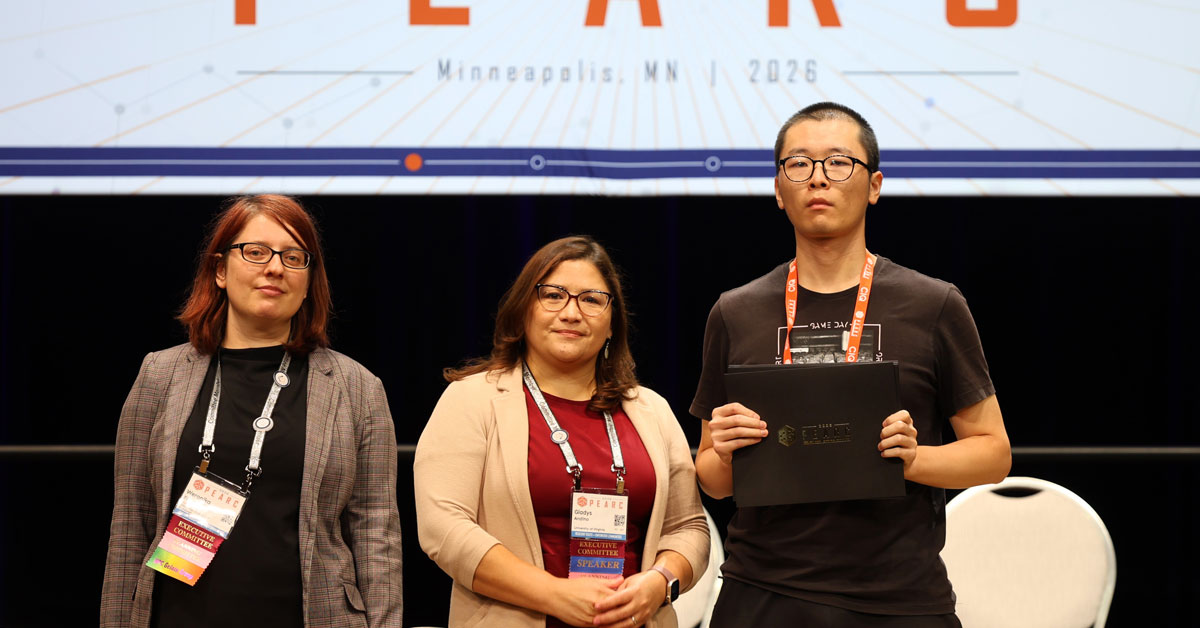
Rutgers University graduate students, working in collaboration with the San Diego Supercomputer Center (SDSC) at the University of California San Diego Halıcıoğlu School of Data Science and Computing, recently won an award for the “Best Student Full Paper (Systems)” at the Practice and Experience in Advanced Research Computing (PEARC) 2026 conference in Minneapolis, Minnesota. Their paper was titled A Comparative Study on LLM-enabled HPC User Support.
The graduate students, Mingkai Zheng and Fangru Linghu, along with collaborators from SDSC, the Texas Advanced Computing Center (TACC) and the University of Chicago, contributed to hpcGPT, a project exploring how to leverage large language models (LLMs) to assist researchers who use high-performance computing (HPC) systems. Zheng and Linghu specifically focused on how to equip LLMs with domain-specific knowledge to improve user support at HPC centers like SDSC by testing methods for tasks such as crafting job scripts, managing datasets and models as well as navigating complex software stacks.
“We compared three techniques: 1) Fine-tuning the base LLM on historical user support ticket data; 2) giving it the ability to look up relevant documents (RAG); and 3) showing it example Q&As directly in the prompt (in-context learning, or ICL),” Zheng said. “We used eight different combinations with 60,000 real support tickets from TACC and graded the results on accuracy, coherence and a few other quality measures.”
Zheng said they found that combining in-context learning with document lookup (ICL+RAG) on the base model gave the most accurate answers overall, while in-context learning alone worked best for debugging questions. Notably, fine-tuning of the model wasn't necessary to get strong results.
“The takeaway is that smart prompting strategies (examples plus real-time lookup) can be a more practical and effective way to build AI-powered support tools for technical computing centers than fine-tuning the underlying model,” said the students’ SDSC collaborator Martin Kandes, who is a senior computational and data science research specialist.
This work was funded by the U.S. National Science Foundation (award nos. 2411294, 2411295, 2411296, 2411297, 2411298, 2411299).
The Best Student Paper recognition at PEARC 2026, combined with NSF’s CSSI Framework support, highlights the critical role of student innovators in reimagining how AI and HPC can work together to serve research communities.