

New $10M NSF Award to SDSC at UC San Diego to Deploy Expanse2
Supercomputer continues to serve the long tail of science and advance AI innovation
Published September 15, 2026

From developing new artificial intelligence (AI) systems to creating data-driven agriculture tools, researchers across the United States increasingly rely on high performance computing (HPC) resources to tackle some of society's most pressing challenges. Simultaneously, both university professors and community college instructors are working toward educating the next generation of students how best to utilize HPC in their communities. To help meet this growing demand, the U.S. National Science Foundation (NSF) has awarded $10 million to the San Diego Supercomputer Center (SDSC) at the University of California San Diego Halıcıoğlu School of Data Science and Computing to deploy NSF Expanse2, a next-generation supercomputer that will support scientific discovery, engineering innovation, AI-driven research and HPC education nationwide.
“Having advanced supercomputers such as Expanse2, which will allow AI and machine learning workloads to run efficiently, is vital for the national research and education community from all areas of science and engineering in the United States,” said UC San Diego Chancellor Pradeep K. Khosla. “SDSC has a demonstrated track record of providing large scale supercomputers and more recently machines architected for artificial intelligence and machine learning workloads, and is a national leader in advancing science and education for the country by providing innovative cyberinfrastructure.”
NSF Expanse2 will replace the NSF-funded Expanse supercomputer, which has supported researchers and educators since late 2020. Building on Expanse, the new system will provide significantly enhanced computing power and data capabilities for scientists across all disciplines, engineers and AI researchers working with increasingly large and complex datasets and simulations.
“Investing in the research infrastructure that enables scientific discovery is essential to maintaining America’s leadership in science and technology,” said Katie Antypas, Senior Science Advisor within the NSF Directorate for Computer and Information Science and Engineering. “Expanse2 represents an important investment in the computing capabilities researchers need to pursue the next generation of scientific and engineering breakthroughs.”
The new system will include the latest generation AMD processors and accelerators, connected through an advanced network designed to support data-intensive workloads, AI, machine learning (ML), modeling and simulation applications. These capabilities will allow researchers to run much larger and more complex scientific simulations, process and analyze much larger datasets, and make advanced computing capabilities accessible to researchers beyond major institutions. NSF Expanse2 will also include an innovative storage architecture that combines a high-performance all-NVMe file system optimized for AI and ML workflows with large-capacity storage designed to ensure system availability and data integrity.
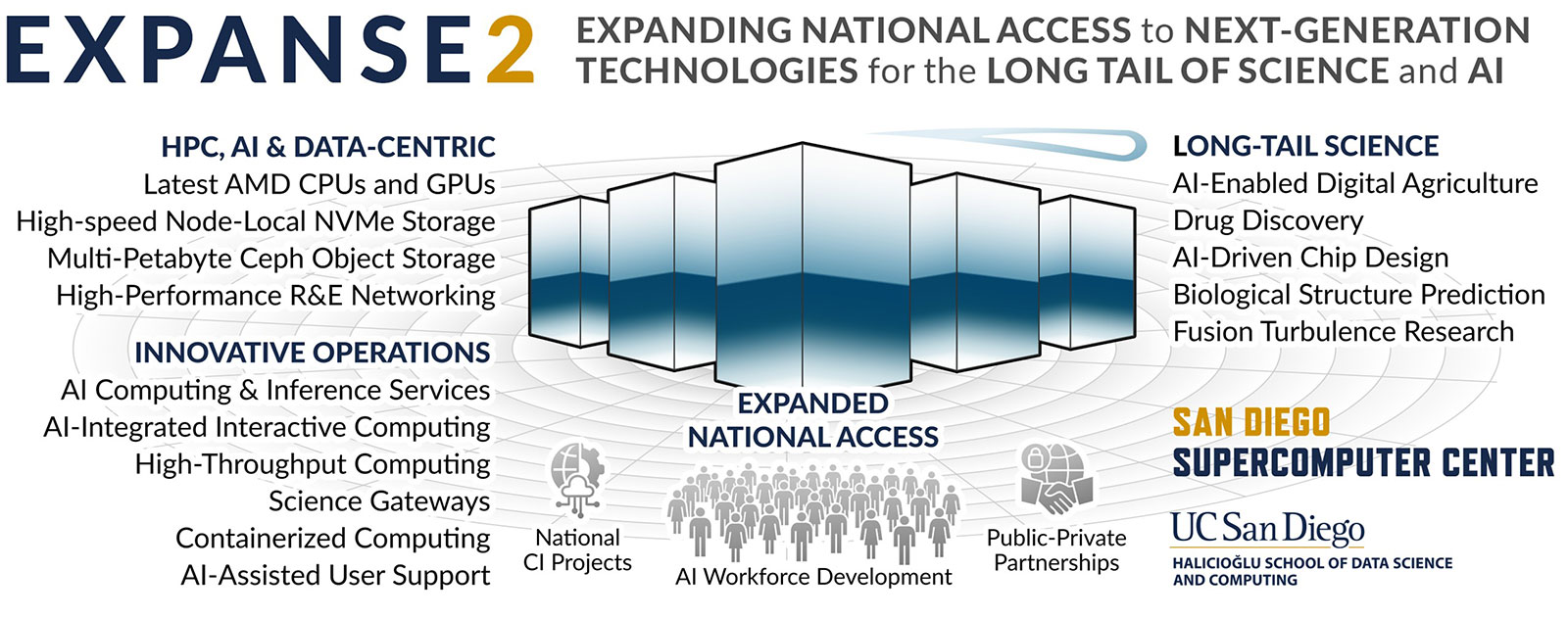
Credit: Ben Tolo, SDSC Communications
NSF Expanse2 aligns with current federal research and development priorities, including efforts to expand access to advanced computing infrastructure and accelerate AI-enabled scientific discovery. It will also contribute to the NSF-led National AI Research Resource, helping expand access to advanced computing and AI capabilities, strengthen U.S. research competitiveness and support the development of the nation's future STEM workforce.
When it enters production in 2027, NSF Expanse2 will be one of the newest resources available to the national HPC community, including researchers participating in NAIRR, supporting both traditional computational science and emerging AI-driven research. Following the success of Expanse, NSF Expanse2 will continue to serve the "long tail of science" and provide access to advanced computing resources for a broad community of researchers, institutions and scientific disciplines.
“Expanse2 will continue the successful path of Expanse, which has served tens of thousands of researchers from all areas of science and engineering,” said Principal Investigator (PI) Michael Norman, who is a computational astrophysicist at UC San Diego and also served as director of SDSC for 2010-2021. “Expanse2 will deliver capabilities that increase the capacity and performance for both batch-oriented and science gateway users, and that enable new research in AI applications and data analytics, which increasingly depend on heterogeneous, distributed and integrated cyberinfrastructure.”
NSF Expanse2 users will be supported by SDSC's long tradition of excellent user support along with education, outreach and training (EOT) activities. Additionally, the HPC system will offer user-friendly allocation and scheduling policies, support rapid application development and data analysis via Jupyter notebooks, provide extensive AI/ML frameworks and libraries, and connect users with federated and extensible data ecosystems.
User support will be focused on delivering the tools, training and support needed to increase productivity and decrease time-to-science results. The user support team has expertise in computational science, AI/ML, data-intensive computing, scientific workflows and large-scale systems operations to support the users at the highest levels of utilization, reliability and usability.
“AI is becoming prevalent among all areas of science and engineering, and the latest generation GPU resources and the all-NVMe file system of the Expanse2 machine will enable the community, and especially the NAIRR user community to effectively carry out application of AI both for training and inference,” said SDSC Director Frank Würthwein, who is also a professor in the Physics Department and the Halıcıoğlu Data Science Institute at UC San Diego.
PI Mike Norman, along with multiple Co-Pis, including Amitava Majumdar, Ilkay Altintas, Subhashini Sivagnanam and Mahidhar Tatineni, as well as senior personnel Christopher Irving and Mary Thomas, have extensive experience operating national systems and participating in the NAIRR effort, which will directly inform NSF Expanse2.
The NSF Expanse2 system will be built on lessons learned during the operation of Expanse to broaden outreach to users from all research domains and institutions, including AI researchers who have not traditionally incorporated HPC into their workflows. While Expanse2 education, outreach and training activities will be focused on domestic workforce development across universities, teaching colleges and high school students to strengthen the U.S. scientific and technical workforce, industry outreach via the SDSC director’s discretionary allocation efforts will foster public-private partnerships.
The NSF Expanse2 project is funded under NSF award number 2614012.