
Researchers and Educators Get Hands-On with HPC at SDSC Summer Institutes
Published September 09, 2026
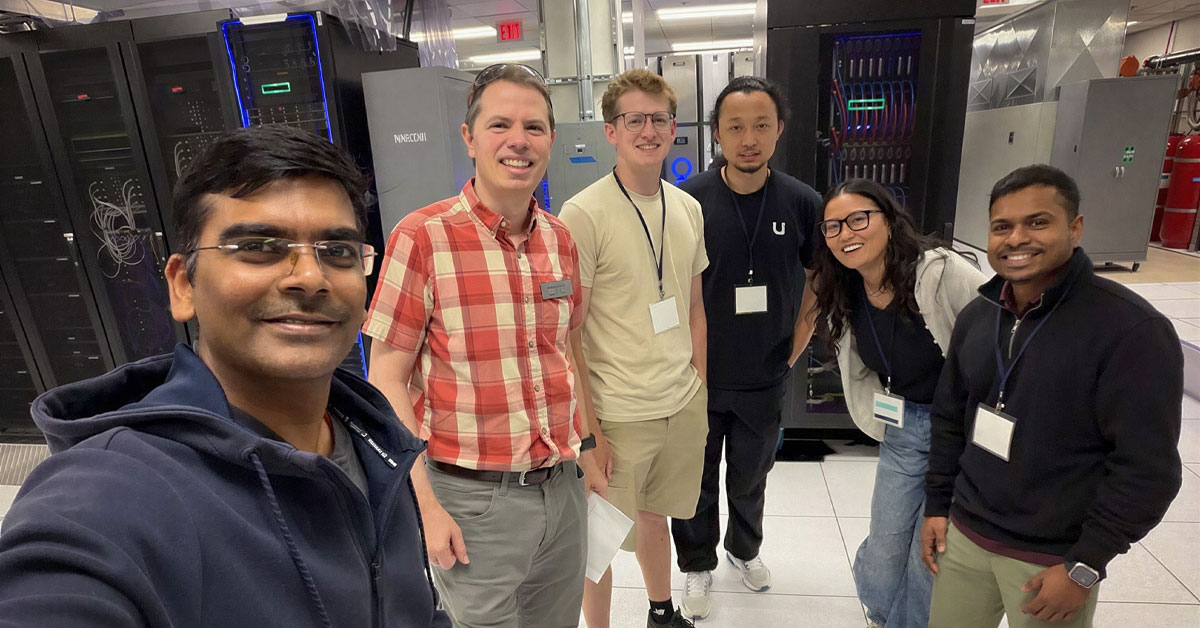
Participants in the 2026 Cyberinfrastructure-Enabled Machine Learning visit the San Diego Supercomputer Center's data center with instructor Andreas Goetz (second from left). Credit: Aadhil Haq, Texas A&M University
Researchers and educators recently gathered at the San Diego Supercomputer Center (SDSC) at University of California San Diego Halıcıoğlu School of Data Science and Computing for the 2026 HPC and Data Science Summer Institute (HPC-DSI-26) and the 2026 Cyberinfrastructure-Enabled Machine Learning (CIML-26) Summer Institute. The annual programs are focused on teaching researchers and students about high-performance computing (HPC) and techniques for scaling data science and machine learning workloads on HPC systems.
During the programs, participants learned directly from SDSC experts and practiced what they learned on the Expanse system, which is funded by the U.S. National Science Foundation. Sessions covered everything from running jobs and managing data on a supercomputer to parallel computing, GPU programming, deep learning and Python for HPC.
“Diving deep into advanced cyberinfrastructure and scalable machine learning was immensely valuable,” said Texas A&M University doctoral candidate Aadhil Haq, who participated in CIML. “As I continue developing workflows and leveraging graph neural networks for peptide binder designing, the hands-on instruction provided critical insights into optimizing resource-intensive models on high-performance clusters.”
The in-person programs were limited to 50 participants each, giving attendees opportunities to meet one-on-one with SDSC experts and talk through computing challenges related to their own research or teaching. Along with learning new computing techniques, attendees spent time connecting with SDSC staff and researchers from different fields and learning how they could apply these tools to their own work.
“The learning does not stop when a session ends. Over coffee, at lunch, and during the reception, participants can discuss the code they use in their research with instructors and peers and get feedback specific to their work,” said Andrea Zonca, who is the director of the HPC and Data Science Summer Institute and lead for the SDSC Scientific Computing Applications group. “These conversations help participants improve their scientific computing workflows and build connections that continue after the institute.”
“Our goal is to help researchers bridge the gap between laptop-scale workflows and computing at scale,” said Mai H. Nguyen, director of the 2026 CIML Summer Institute. “These workshops provide participants practical skills to scale their data science and machine learning workloads and use HPC resources effectively to maximize their research impacts.”
HPC-DSI-26 training materials are available at github.com/sdsc/sdsc-summer-institute-2026.
CIML-26 teaching materials are available at https://github.com/ciml-org/ciml-summer-institute-2026.
CIML was supported by NAIRR Pilot and Expanse, while the HPC-DSI was supported by the Expanse and Cosmos projects.