

SDSC Teams with General Atomics to Advance Ultrafast High-Energy Laser AI Research via Voyager
Published August 21, 2026
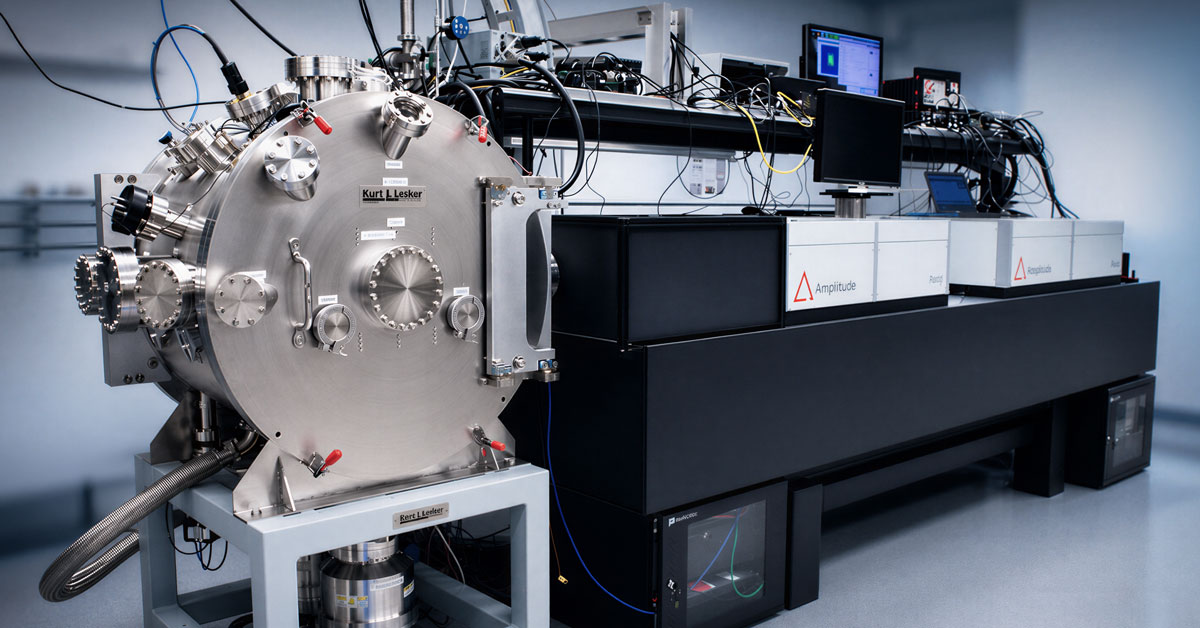
The GALADRIEL lab at General Atomics is built around a terawatt-class, ultra-short pulse sapphire laser system. Credit: General Atomics
Researchers from General Atomics (GA) and the San Diego Supercomputer Center (SDSC) at the University of California San Diego Halıcıoğlu School of Data Science and Computing have worked together on a new study that shows how artificial intelligence (AI) can help control ultrafast high power laser systems, potentially advancing microchip manufacturing, improving non-destructive scanning of cargo and waste, and providing new tools for medical therapies.
Recent advances in technology now make it possible to generate ultrashort laser pulses lasting just tens of femtoseconds at terawatt-level peak powers and increasingly high repetition rates. Such laser pulses are used to study how lasers interact with their targets, how secondary sources of radiation develop and how energy can be obtained from inertial fusion – a nuclear fusion process that compresses and heats targets filled with fuel.
These modern high-power lasers require painstaking manual calibration to create the exact pulse shape scientists need (the graphical curve of a brief laser pulse as it changes over time). Because the systems are highly nonlinear and produce enormous amounts of data, humans cannot adjust them quickly enough, creating a bottleneck for research and applications.
The SDSC and GA team focused on using AI data-driven models that exploit the large amount of data points recorded for these experiments to control laser input parameters to get the right laser pulse shape. The collaboration used SDSC’s Voyager AI system, which is funded by the U.S. National Science Foundation (NSF), to train machine learning models on datasets with more than tens of thousands of laser shots, where laser input parameters and output pulse shapes were recorded. The models then “learn” the nonlinearities of a laser system and predict the input parameters needed to generate the laser pulse shape necessary for the desired target.
Secondary radiation sources use these ultra-short, high-intensity laser pulses to excite matter to extreme conditions to produce bright photon, ion, electron, or neutron beams. Some examples of laser-driven secondary radiation sources include Extreme Ultraviolet (EUV) lithography for semiconductor manufacturing, gamma rays non-destructive active interrogation of dense container material and targeted hadron cancer therapy development.
These models can reduce the time it takes to recreate laser pulse shapes from an hour to minutes, yielding to more productive experimental campaigns. Because Voyager is purpose-built for AI workloads, the researchers could explore many model designs and quickly test how each one might work in a realistic control scenario.

“Our work shows how advanced AI running on systems like Voyager can move us from manual laser input parameter turning to automatic recalibration,” said SDSC Director Frank Würthwein, who holds faculty appointments at UC San Diego in the Physics Department and the Halıcıoğlu Data Science Institute. “By pairing GA’s decades of science and physics expertise with SDSC’s AI-focused cyberinfrastructure, we are opening up new ways to control complex systems that were previously too fast and too nonlinear to manage with traditional methods.”
The experiments were performed at the General Atomics Laboratory for Developing Rep-rated Instrumentation and Experiments with Lasers (GALADRIEL). While GA contributed deep knowledge of physics and experimental operation, SDSC provided the computing platform and AI workflow needed to turn that knowledge into a data-driven control approach. Würthwein said that this work is an example of how collaboration between experimental scientists and computing experts can accelerate progress toward fusion energy.
“High power laser systems generate light pulses by using a nonlinear system that amplifies an initial signal. Producing a requested pulse shape implied a tedious manual calibration of the laser input parameters,” said lead study author Javier Hernandez Nicolau, a computational data scientist at SDSC. “Now, the AI model can quickly provide the input to the laser system that produces the requested laser pulse. Voyager gave us a platform where we could train sophisticated models on realistic data and then evaluate how those models would behave in a control setting, all before deploying anything in an experimental device.”
“Voyager’s Gaudi AI processors power scientific breakthroughs across multiple fields,” said Amit Majumdar, PI of the Voyager project and director of the Data Enabled Scientific Computing division at SDSC. “These include AI models for high-energy particle colliders, cervical cancer treatment planning, high-resolution galactic dust imaging, and now ultrafast high-energy laser research.”
The researchers see this as an important step toward future high-energy ultra-fast laser systems that use AI not just as an analysis tool, but as a core part of how experiments are operated.
“This work demonstrated a machine learning framework for controlling laser pulse shapes at the femtosecond level using as-shot experimental data,” said study co-author and GA scientist Mario Manuel. “The model can be tuned daily to provide accurate control of ultra-short laser pulses to improve the efficiency of future laser-based radiation sources.”
This study was published in APL Machine Learning journal.
The work at General Atomics was supported by internal research and development funds. This study was also supported by the U.S. Department of Energy (award no. DE-SC0024426). The machine learning models used the resources of the Voyager system, which is located at SDSC and funded by NSF (award no. 2005369).