

United Nations Holds Southern California’s First Hackathon at UC San Diego
Published July 23, 2026
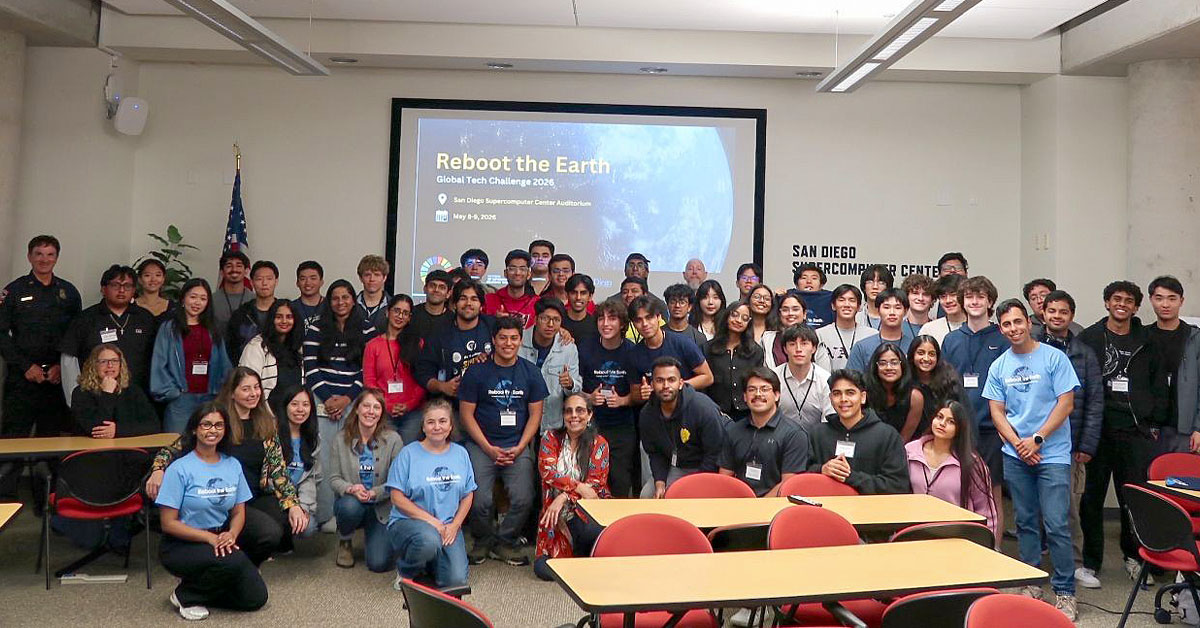
The participants of Southern California’s Reboot the Earth event included a range of ages, from high schoolers to university students.
A United Nations’ (UN) Hackathon recently took place at the University of California San Diego Halıcıoğlu School of Data Science and Computing San Diego Supercomputer Center (SDSC). The event was a collaboration between the UN, SDSC Societal Computing and Innovation Lab (SCIL), the UC San Diego Library's Open Source Program Office (OSPO) and the University’s Office of Innovation and Commercialization.
Reboot the Earth initiative focuses on themes related to utilizing technology to create solutions for an array of international climate crises relevant to the specific location of each hackathon. For the UC San Diego edition, the focus was on wildfires. Undergraduates and developers from a variety of STEM fields gathered for the two-day challenge of creating software applications for wildfire prevention and management. The UC San Diego event was a true international affair with students from Mexico and a UN representative present.
Participants worked in teams to find their own unique paths converging into a collaborative effort, exploring the ways solutions garnered by technology can come to life.
UC San Diego students Laksh Goyal, Pranay Yalamanchali and Himir Desai designed a program called “AgriShield” to guide and protect farms using a single software. The team’s program personalizes detections of wildfire pathways according to the user’s selected land parcel. Users receive suggestions for different prevention methods, such as firebreaks and water points.
“Our goal was to make planning quicker, easier and more specific than a simple warning of high risk before wildfire season,” Goyal said. “This was my first hackathon and while we did not win, I learned a lot as we built something I genuinely care about, and met some really thoughtful people along the way.”
Team 619°, composed of UC San Diego and San Diego State University students Aadi Beri, Alex Ziao, Juee Deshmukh, Tue Tan and Adelina Martinez, took home the first place prize. Their creation, “Firelink,” functions as a hotline based on texting, aiming for quick communication in times of crisis.
Three finalists included Team Scorched. The UC San Diego students created re:scorched, a public awareness platform to provide communities with information about controlled burns. The platform, which couples satellite imagery with environmental data, also features a decision-making tool for wildfire researchers and first responders.
The Wildfire Wizards - SafeHerd team, which consisted of students from both UC San Diego and California State University San Marcos, was an additional finalist in the hackathon and developed SafeHerd, a San Diego County wildfire livestock evacuation system. SafeHerd provides a way for livestock owners to create plans to take their animals to safety during fire evacuations. The application also includes multi-language evacuation preparation checklists.
One more finalist was a UC San Diego student team coined AgroPal, which created a tool also called AgroPal. The platform specifically monitors the risk of wildfire from satellite data and auto-activates if there is a threat to the AgroPal user. The user then receives a multilingual PDF with a ranked crisis checklist, an evacuation route, a financial exposure summary, a pre-filled insurance form and a curated list of relief programs.
“We were honored to open the hackathon with our panelists, Joelene Tamm, Natural Resources Director at the La Jolla Band of Luiseño Indians, and Eric Just, Pre-Fire Division Chief at CAL FIRE,” said Melissa Floca, SCIL Chief Innovation Officer. “Their perspectives on our relationship with wildfire in Southern California grounded the event in local realities and provided valuable context for the discussions and work that followed.”
Floca’s sentiments reflect the true nature of this Hackathon: not simply a showcase of skill, but an opportunity to glimpse a promising future through the minds of our next generation.