
UC San Diego Awarded $4.85M to Grow NEMAR into HPC Hub for Neuro-AI
Published May 26, 2026
The University of California San Diego has received $4.85 million from the National Institutes of Health (NIH) to bolster a platform that makes available large-scale neuroscience data together with high-performance computing (HPC) resources, providing new possibilities for neuroelectromagnetic brain and body research.
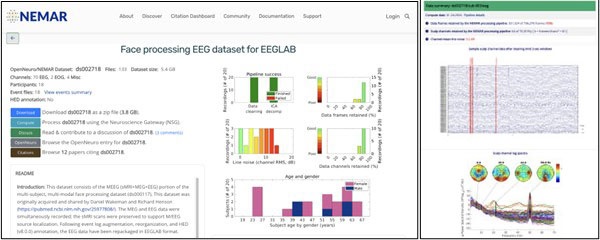
The NeuroElectroMagnetic Data Archive and Tools Resource (NEMAR) platform has emerged as a key infrastructure for sharing and analyzing human neurophysiology data, particularly electroencephalography (EEG) and magnetoencephalography (MEG). The platform connects curated datasets from OpenNeuro and other sources with compute resources at the UC San Diego Halıcıoğlu School of Data Science and Computing’s San Diego Supercomputer Center (SDSC), enabling researchers to run large-scale analyses without needing to first transport the data to distant resources.
A central feature of the integrated NEMAR and Neuroscience Gateway system is its integration with SDSC’s Expanse supercomputer, where the NEMAR datasets are mounted directly. This architecture allows users to analyze up to petabyte-scale data in place, eliminating the need for time-consuming transfers and lowering barriers to entry for compute-intensive neuroscience workflows. Through its integration with the Neuroscience Gateway, NEMAR also provides streamlined access to scientific software tools including EEGLAB, MATLAB, Python, TensorFlow and PyTorch.
The continued funding will support a significant expansion of NEMAR’s artificial intelligence (AI) capabilities. The team plans to develop multimodal foundation models trained on large-scale neuroelectromagnetic datasets, combining brain signals with behavioral and participant-level metadata. These models are expected to support a range of downstream applications, including data quality assessment, cross-modal analysis, cognitive state decoding and brain-computer interface development.
“NEMAR is at the cutting edge of open neuroscience infrastructure, and this new phase of funding should allow us to explore exciting new opportunities in statistical and artificial intelligence modeling of how our brains support our experience and behavior,” said Scott Makeig, co-principal investigator and director of UC San Diego’s Swartz Center for Computational Neuroscience at the Institute for Neural Computation.
“By combining data formatted using accepted standards with readily accessible high-performance computing, we can train large models that generalize across experiments,” said Arnaud Delorme, co-principal investigator of the project and co-director of the Swartz Center for Computational Neuroscience at the Institute for Neural Computation.
The platform’s emphasis on standardized data remains central to its design. NEMAR supports the Brain Imaging Data Structure (BIDS) and incorporates detailed event annotations using the Hierarchical Event Descriptor (HED) system, enabling interoperability across tools and research groups. These standards are critical for scaling machine learning workflows across heterogeneous datasets.
In addition to advancing infrastructure and AI development, the project plans to expand its training and outreach efforts. Workshops and tutorials will focus on data standards, signal processing, and machine learning methods, helping researchers effectively use HPC-enabled tools for neuroscience analysis.
According to Amitava Majumdar, co-principal investigator of the NEMAR project and director of SDSC’s Data Enabled Scientific Computing Division, the coupling of data and compute is key to the platform’s impact.
“By colocating large-scale datasets with high-performance computing resources, we enable researchers to focus on analysis rather than data logistics,” Majumdar said. “This funding allows us to further scale that model and extend access to a broader community.”
As the volume and complexity of neuroscience data continue to grow, platforms such as NEMAR are enabling HPC infrastructure to be a critical enabler of data-driven research and discovery. The next phase of the project aims to further integrate large-scale data, advanced AI methods and accessible compute resources to support a new generation of computationally intensive brain research.
The project is funded by the NIH’s National Institute of Mental Health (R24-MH120037). The new award (R24-MH120037) will support the project from April 2026 through December 2030 and is part of the NIH Brain Research Through Advancing Innovative Neurotechnologies (BRAIN) Initiative resource for sharing neuroelectromagnetic data. NEMAR is led by principal investigators (Co-PIs) Scott Makeig, Amitava Majumdar, Taylor Berg-Kirkpatrick and Arnaud Delorme at UC San Diego, and Russ Poldrack at Stanford University, with collaborators Srikantan Nagarajan at UC San Francisco and Kay Robbins of the University of Texas at San Antonio. SDSC researchers Subha Sivagnanam, Choonhan Youn and Yahya Shirazi are involved in this project.