
How SDSC and CENIC Are Bringing AI Infrastructure to California's Classrooms
Published May 13, 2026
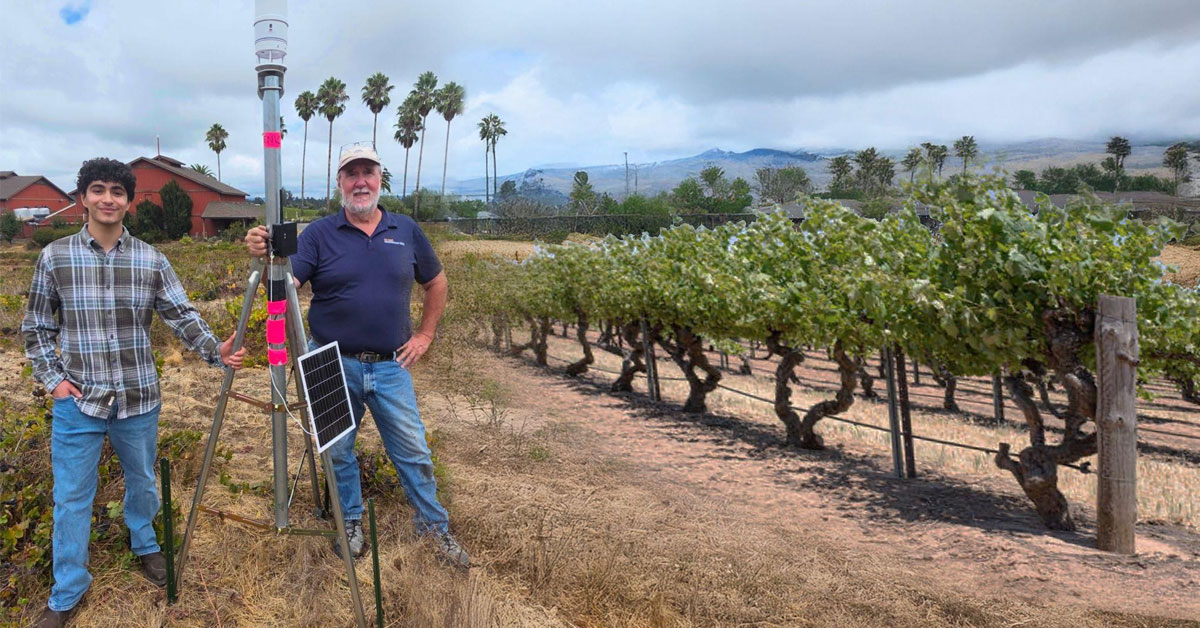
Student Alex Nava and research scientist John Graham meet in the vineyard. Credit: CENIC AIR
The San Diego Supercomputer Center (SDSC), part of the Halıcıoğlu School of Data Science and Computing at the University of California San Diego, is working to expand equitable access to advanced computing infrastructure, positioning America’s classrooms for an AI-driven future. Through partnerships, platform development and on-the-ground deployments, SDSC is helping redefine how research infrastructure can directly support education, workforce development and economic opportunity.
Alongside its national leadership, SDSC also plays a pivotal role in California by developing and operating the Corporation for Education Network Initiatives in California (CENIC) Artificial Intelligence Resource (CENIC AIR) — a distributed, statewide AI infrastructure that lowers the total cost of ownership, enabling community colleges and California State Universities (CSUs) to invest in and own a share of the system.
“Of more than 400 accredited, degree-granting institutions in California, only 14 are classified as research-intensive (R1) universities, the kind that might plausibly afford a dedicated team of system administrators, cybersecurity professionals and user-support staff to run their own AI infrastructure,” said SDSC Director Frank Würthwein. “That is less than 3.5 percent of California colleges while the other 96.5 percent, including 116 community colleges serving 2.2 million students, and 23 CSUs serving nearly half a million more, face a stark choice: pay for expensive commercial cloud resources, go without or find a different model.”
SDSC, in partnership with CENIC, is building that new, more equitable model: CENIC AIR.
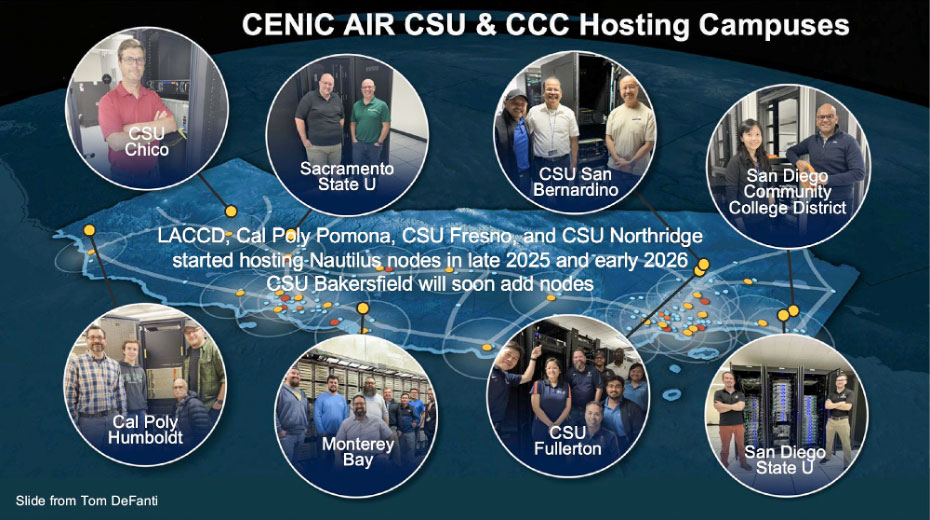
As of March 2026, CENIC AIR encompasses hardware at more than 20 California campuses, spanning both the UC and CSU systems as well as community college partners. The network includes 1,044 GPUs and 14,604 CPU cores, backed by over ten petabytes of storage.
CENIC AIR takes a page from the cloud provider playbook: centralize the expensive, expertise-intensive operations while decentralizing the hardware investments. Colleges own their equipment and install their own data centers, while CENIC and SDSC handle operations, security and support across all sites. This approach achieves economies of scale without sacrificing institutional ownership.
Case Study: Data-Driven Agriculture in Action
One of the most creative demonstrations of SDSC and CENIC partnering their expertise in the real world is the Iron Horse Vineyards project. A data-driven agriculture testbed near Sebastopol, California, the project uses soil, air and vine sensors connected via LoRaWAN low-power networks, drone-based multi-spectral imaging and a 10-Gigabit CENIC router to generate continuous, actionable data about crop health and harvest timing.
The project is led by Thomas DeFanti, a research scientist at UC San Diego’s Qualcomm Institute and a distinguished professor emeritus of computer science at the University of Illinois at Chicago, in collaboration with Iron Horse owner Joy Sterling. The team includes partners and students from Santa Rosa Junior College, Sonoma State University, UC San Diego, UC Agriculture and Natural Resources and industry partners including AT&T.
“The Iron Horse project achieved multiple technical milestones in 2025, including completion of a last-mile fiber connection and initial sensor deployments, making data transmission from vineyard to researchers a reality,” DeFanti said. “The challenge now being addressed: collating diverse data streams into a coherent precision agriculture intelligence platform.”
Projects like Iron Horse point to a broader opportunity: SDSC’s model can support similar place-based, data-intensive collaborations across sectors — from agriculture to climate monitoring to smart infrastructure — while simultaneously creating hands-on learning opportunities for students across California’s higher education system.
What’s Next?
California's Master Plan for Higher Education created a deliberate pathway: community colleges feed into CSUs and UCs. Today, 30 percent of UC incoming classes are community college transfer students; 50 percent of CSU classes arrive that way. As CSUs and UCs deploy digital assets in the classroom at scale, UC San Diego reached 24 percent of all undergraduates and one-third of all graduate students in the 2025 academic year.
Community colleges must keep pace and CENIC AIR allows just that by preparing transfer students in a classroom environment on the same level as their destination institutions.
Würthwein said that SDSC and CENIC AIR's strategy directly addresses this equity gap. “By allowing community colleges to join the same shared infrastructure used by major research universities, with CENIC and SDSC handling the operational complexity, the platform democratizes access to tools that would otherwise be out of reach for most two-year institutions,” he said.