

SDSC’s Expanse Helps Illustrate How to Break ‘Forever Chemicals’ in Real Time
Published April 06, 2026
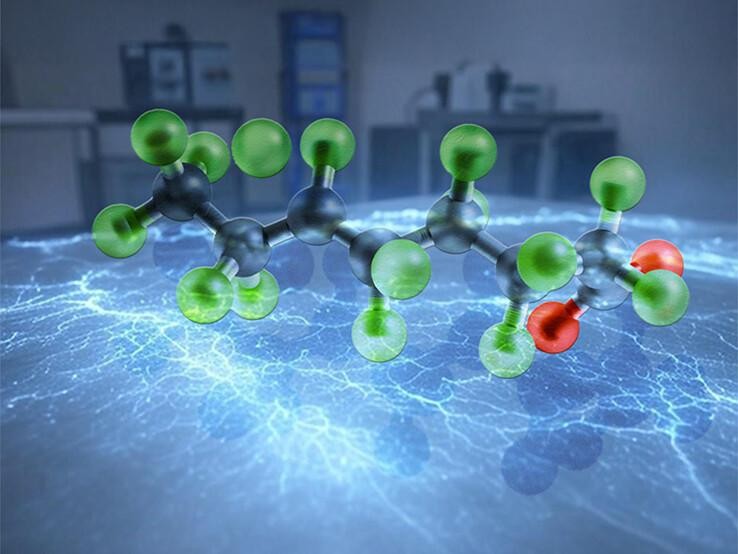
Scientists have, for the first time, watched “forever chemicals” break apart step by step on an electrically charged metal surface, pointing to new ways to remove them from drinking water. Using the Expanse supercomputer at the University of California San Diego School of Computing, Information and Data Sciences’ San Diego Supercomputer Center (SDSC), the team focused on better understanding PFAS, a large family of man-made chemicals used in products like nonstick pans and firefighting foams that linger for decades in the environment and are linked to health concerns.
In a new study in Environmental Science & Technology Letters, a team from the University of California, Riverside, led by postdoctoral associate Kamal Sharkas and professor Bryan Wong, ran detailed computer experiments of a common PFAS compound on a copper surface under an applied voltage. Instead of just taking static snapshots, they followed how the molecule’s atoms moved over time and how key bonds in the chemical backbone began to stretch and finally snap. Those bonds, between carbon and fluorine atoms, are what make PFAS so tough to destroy in the first place.
The significance of this study lies in showing, at the atomic level, exactly how and when PFAS bonds can be broken using electrochemical means; that is, by applying an electric charge to a metal surface submerged in water. The new findings translate fundamental chemistry into actionable engineering guidance, which is a crucial step toward affordable, effective PFAS remediation in the drinking water supplies that communities depend on.
“Our simulations showed that when the metal surface was made electrically negative enough, extra electrons rushed into the PFAS molecule, weakening specific carbon–fluorine bonds until they broke and released fluorine into the surrounding liquid, matching what lab experiments had hinted at before,” said Wong, a chemistry professor at UC Riverside. “At milder voltages, however, those ultra-strong bonds stayed mostly intact, helping explain why many treatment approaches struggle to fully eliminate PFAS.”
Running these kinds of “real-time” virtual experiments is enormously demanding, which is why the researchers turned to U.S. National Science Foundation allocations on SDSC’s Expanse. They used thousands of computing cores to follow the motion of atoms over more than a trillionth of a second, which is long enough in the microscopic world to see several of the toughest bonds in the PFAS chain stretch by more than half their normal length and then break. When the team tried a simpler approach using smaller calculations that did not realistically allow electrical charge to flow, they did not observe any bond breaking at all, underscoring the need for full-scale electrochemical simulations.
“This new way of using supercomputers could be a powerful design tool for future PFAS cleanup technologies,” Wong said. “By swapping in different electrode materials in the model and adjusting the voltage, we can quickly test which combinations are most likely to pull apart PFAS efficiently and with less energy, before building costly hardware.”
The project was supported by the U.S. Department of Energy, and support on Expanse was provided by NSF ACCESS (allocation no. CHE240173).