
SDSC’s CloudBank: Empowering Recovery in Weather-Ravaged Communities
Published December 23, 2025
A Personal Mission Rooted in Katrina’s Human Toll
As a young researcher, Joshua Behr witnessed firsthand how Hurricane Katrina and subsequent failures during the longer-term recovery fracture lives, long after the floodwaters receded. Watching displaced families struggle through the painfully slow process of housing repair set him on a trajectory to determine how technology can be applied to expedite delays and better support recovery organizations. Katrina’s human toll was staggering — 270,000 homes destroyed or damaged, 1.5 million people displaced and nearly 1,400 lives lost in New Orleans alone — Behr’s own father-in-law among them. Two decades later, Joshua Behr’s ongoing mission is to bring clarity, coordination and compassion to repair and rebuild efforts.
While Katrina is notable due to its scale, severe weather events damage or destroy homes and displace millions of Americans each year, upending entire communities. Often traumatized, vulnerable and medically fragile families experience cycles of temporary housing, delayed repairs and uncertainty in returning to a safe and stable future. To speed the repair and rebuilding of damaged homes, Joshua Behr leads a team at Old Dominion University (ODU) in developing a cloud-based platform for coordinating long-term disaster recovery.
CloudBank’s Role in Powering a New Model for Disaster Recovery
With support from CloudBank — a U.S. National Science Foundation (NSF)-funded service that provides access to commercial cloud resources to support federally-funded researchers — the Convergence, Inventory, Matching and Assignment (CIMA) platform will deliver fast, secure and scalable tools to critical recovery organizations.
CloudBank facilitated CIMA’s use of commercial cloud services by providing funding and services to streamline and manage their access to Amazon Web Services. This enables the CIMA team to focus on building their innovative solution.
“Our role was to ensure CIMA had reliable access to cloud resources so they could focus on helping recovery organizations and volunteers,” said Shava Smallen, CloudBank’s leader and a research scientist at the San Diego Supercomputer Center (SDSC), part of the School of Computing, Information and Data Sciences at the University of California San Diego.
For ODU research professor and CIMA Lead Joshua Behr, the project’s mission has remained deeply personal. “In disasters like Katrina, the trauma of losing everything you’ve ever known can break you psychologically,” Behr said. “With CIMA, we want to empower relief organizations to increase the quality of communication, coordination, and data capture; deliver frictionless case management; optimize project management — and, above all, to make it as easy as possible for affected people to get help and navigate the process.”
A Platform Built to Rebuild Communities
Behr’s commitment led him to systematically interview hundreds of survivors, relief workers, nonprofits and volunteers, as well as to provide access to the cloud-based platform to the recovery organizations performing the vital repair and reconstruction efforts. These insights are helping refine CIMA into a user-friendly, transparent system that strengthens coordination, giving recovery teams the situational awareness they need to work together more effectively.
“As we develop CIMA, we’re integrating best supply chain practices with fundamental managerial principles,” said Rafael Diaz, an ODU professor who co-leads the project with Behr. “Our objective is to streamline operations, improve visibility and heighten coordination and productivity to reduce the time displaced populations spend waiting for housing recovery.”
The CIMA system encompasses an array of portals for its users: applicants (those displaced households requesting repair/rebuild assistance), administrators, case managers, construction managers and volunteers. With the applicant portal, disaster survivors can request help and get clear updates and ongoing completion-time estimates. The volunteer portal matches volunteers by expertise, then allows them to directly communicate with teammates and project leads. The organization portal is a space where administrators will coordinate recovery operations, assign individuals’ roles and responsibilities, provide access and share secure case information — all from a master cloud dashboard. In addition, CIMA will allow for the sharing and portability of case data across organizations and offer mapping and analysis functions.
“We were able to deploy our multi-tenancy architecture easily and reliably using CloudBank resources, allowing organizations to share information supporting recovery,” said Katie Smith, an assistant professor at ODU who leads the software development and cloud deployment. “CloudBank also puts powerful computational resources at our fingertips, accelerating algorithms for matching resources to need.”
Joshua Behr explained: “By running in the cloud, CIMA will connect partner organizations for situational awareness and information sharing, prioritizing vulnerable homes early and tracking volunteer engagement — speeding recovery and reducing gaps in service.”
NSF CIVIC Initiative Bridges Research and Recovery
Through NSF’s Civic Innovation Challenge (NSF CIVIC), the foundation has taken a critical step in bridging the gap between science, technological innovation and community needs. Fundamental research and modeling can take years or even decades to leave the lab, but NSF CIVIC accelerates that process by enabling collaboration among researchers, local governments, nonprofit organizations and impacted populations, turning research and innovation into real, community-driven solutions. “Thanks to CloudBank’s infrastructure and NSF CIVIC,” added Behr, “CIMA will be able to move from pilot to ‘soft deployment’ in real recovery scenarios. Further, during urgent events, the system will automatically scale up computing and data resources to allow peak performance amid large disasters.”
Scientific Innovation Translates into Hope for Storm-damaged Communities
Smallen added “CloudBank is proud to play a role in advancing solutions that make a tangible difference in people’s lives. By enabling projects like CIMA to leverage commercial cloud resources efficiently and securely, CloudBank helps transform innovative ideas into operational systems that support communities during their most vulnerable moments.”
|
CloudBank is available for allocations through the U.S. NSF ACCESS and NAIRR Pilot programs. The ODU project utilized Amazon Web Services. Additional commercial clouds currently available through CloudBank include Google Cloud, IBM Cloud and Microsoft Azure. |
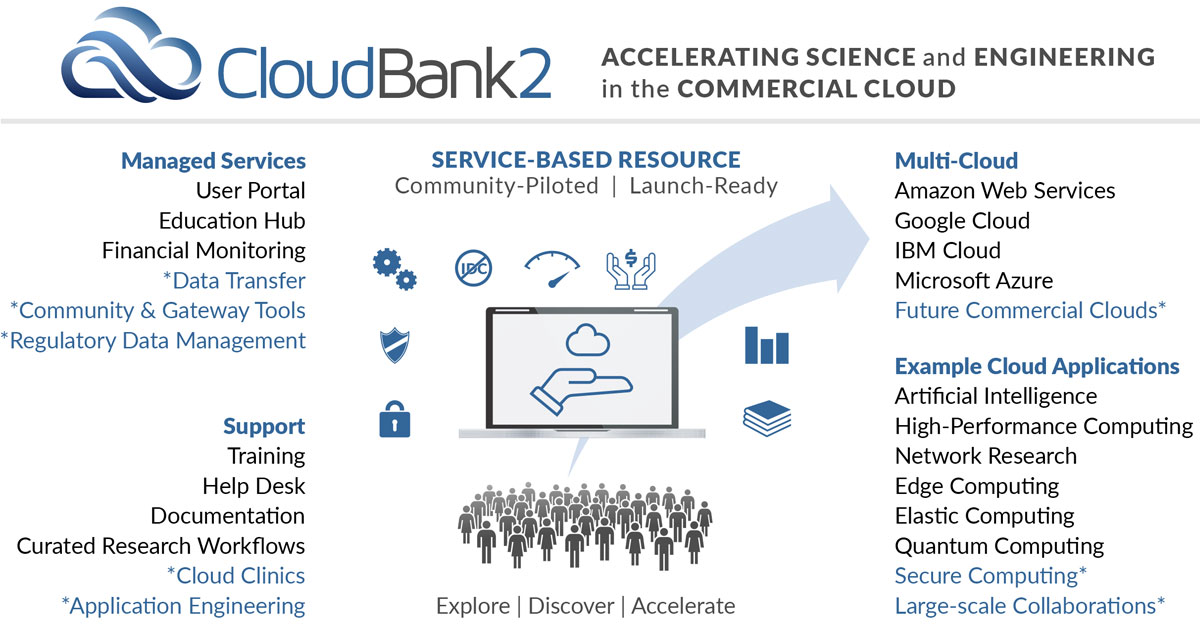
SDSC and the Information Technology Services Division at UC San Diego, the University of Washington's eScience Institute and UC Berkeley's College of Computing, Data Science and Society developed and operate CloudBank, which is funded by the U.S. NSF (award nos. 1925001 and 2505560).