ne
of the goals of the California Institute forTelecommunication
and Information Technology, or Cal-(IT)2, (see related article p.
8) is to extend the power of telecommunications and information
technology to provide scientific data to support public policy development
and serve real-time needs of professionals in the field. Awarded
December 7, 2000, Cal-(IT)2 is a partnership between UCSD and UC
Irvine that features key involvement
of SDSC and the PACI partnerships to leverage grid technology in
new ways.
As one example of an early project, Cal-(IT)2
will partner with SDSC, the Scripps Institution of Oceanography,
the UCSD Structural Engineering Department, and UC Irvine's Department
of Civil and Environmental Engineering and the Institute of Transportation
Studies. Cal-(IT)2 will extend the anticipated emergence of an
all-optical core of the wired Internet with a digital wireless
infrastructure to enable inclusion of sensing devices as new "end
points" on the Internet. This development will enable us to monitor,
manage, and interact with our world in fundamentally new ways-all
based on scientific data, whether it's data accessed and evaluated
in real time or in concert with analysis of decades of previously
collected data to evaluate trends and predict the potential for
a specific event of interest. What is particularly exciting here is that
these sensors will be able to monitor an unusually wide variety
of "environmental indicators" broadly conceived, including:
- Seismic activity and its impact on the civil infrastructure
(e.g., housing, bridges, dams, and roadways).
- Snowpack and water runoff (indicators of the ongoing availability
of water).
- Coastal water conditions (e.g., wave heights during storm
conditions, indicating potential for damage to oceanfront homes).
- Pollution in the water system (e.g., the presence of chromium
VI, a potential carcinogen, and E. Coli, which has forced repeated
beach closings at Huntington Beach in the Los Angeles area).
- Transportation loads on critical freeways (this information
will be used to suggest alternate, less congested routes to
drivers).
- Emergency situations that alert public authorities (police,
highway patrol, hospital emergency rooms) with respect to problems
and projected injuries related to failing bridges, accident
conditions along roadways, and so on.
Significantly, it will even be possible to
extend such monitoring to one's home. Imagine a scenario in which
an elderly patient, who by today's standards might need to be
in a hospital, can maintain a relatively normal lifestyle at home-through
Internet monitoring of his insulin levels or potentially irregular
heart beat. Sensors, now being designed, will be able to reside
on-ultimately within-the human body, such that these types of
patients will be able to live in their homes but be only an Internet
"phone call" away to their emergency provider when their health
dictates. Addressing these needs is clearly a tall order:
The amazing thing is that it's possible. The first step the institute
plans to take to realize this capability is to begin instrumenting
the "High Tech Coast," a region roughly defined by Irvine to the
north and San Diego and the Tijuana, Mexico, area to the south-an
approximately 100-mile area north to south. Cal-(IT)2 will take
the lessons learned from groundbreaking projects such as the High-Performance
Wireless Research and Education Network (HPWREN) led by SDSC and
the Scripps Institution of Oceanography to extend wireless networking
to Orange County, Yosemite Valley, the offshore environment, and
possibly as far north as Pt. Concepcion, Santa Barbara, and Monterey.
HPWREN has already constructed a high-performance wireless backbone
connecting UCSD with remote areas of San Diego County (see story
p. 16). Critical to the Cal-(IT)2 testbed will be
the computing, communications, data, and visualization infrastructure
that will be architected as part of the institute's first-year
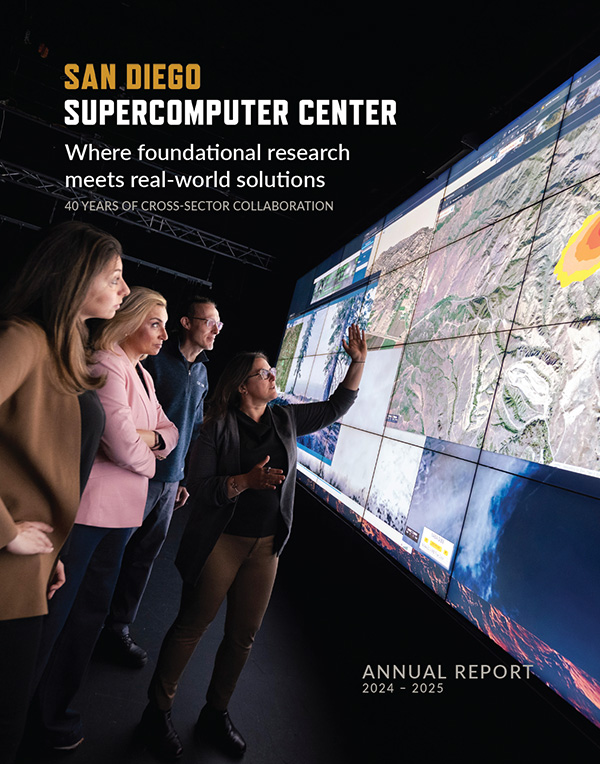
activities. The "user interface" will be a prototype control room,
a command-and-control venue where scientists and policy makers
can access, "fuse," and evaluate data to support decision making.
In this context, the institute, in tandem
with industrial partners, will prototype technologies so that
the latter can evaluate the usefulness of the emerging technologies
and identify potential market niches important to the overall
integrated Internet as it evolves and new applications opportunities
emerge. More exciting still, we expect this infrastructure
will be both scalable and exportable to other regions, even other
countries. For instance, more than half of the world's population
lives within 50 miles of a coast. As others see the benefit of
this instrumentation plan, we expect they'll want to adopt the
technology, and we're prepared to help them. 
|
By Larry Smarr
Institute
Director, California Institute for Telecommmunications and Information
Technology |